Research Studies

​While many, myself included, recognize the daily challenges of living with skeletal dysplasia, it’s hard to find effective solutions without fully understanding the impact. If navigating everyday tasks is significantly more difficult due to physical barriers, shouldn’t we be doing more to create accessible environments? The following includes a detailed case study from the National Library of Medicine exploring how skeletal dysplasia affects daily life, which helped me develop more targeted questions for a survey I conducted within the Little People of America community about the specific challenges people face in finding resources and support.

Case Study

Challenges to self-care and domestic life for adults with disproportionate short statured skeletal dysplasia

Aim

The study aimed to assess how skeletal dysplasia affects daily functioning and the use of assistive products, using the International Classification of Functioning, Disability, and Health (ICF) framework.

Participants

The study included 203 individuals with skeletal dysplasia and 55 control subjects matched by age, gender, and place of residence.

Results

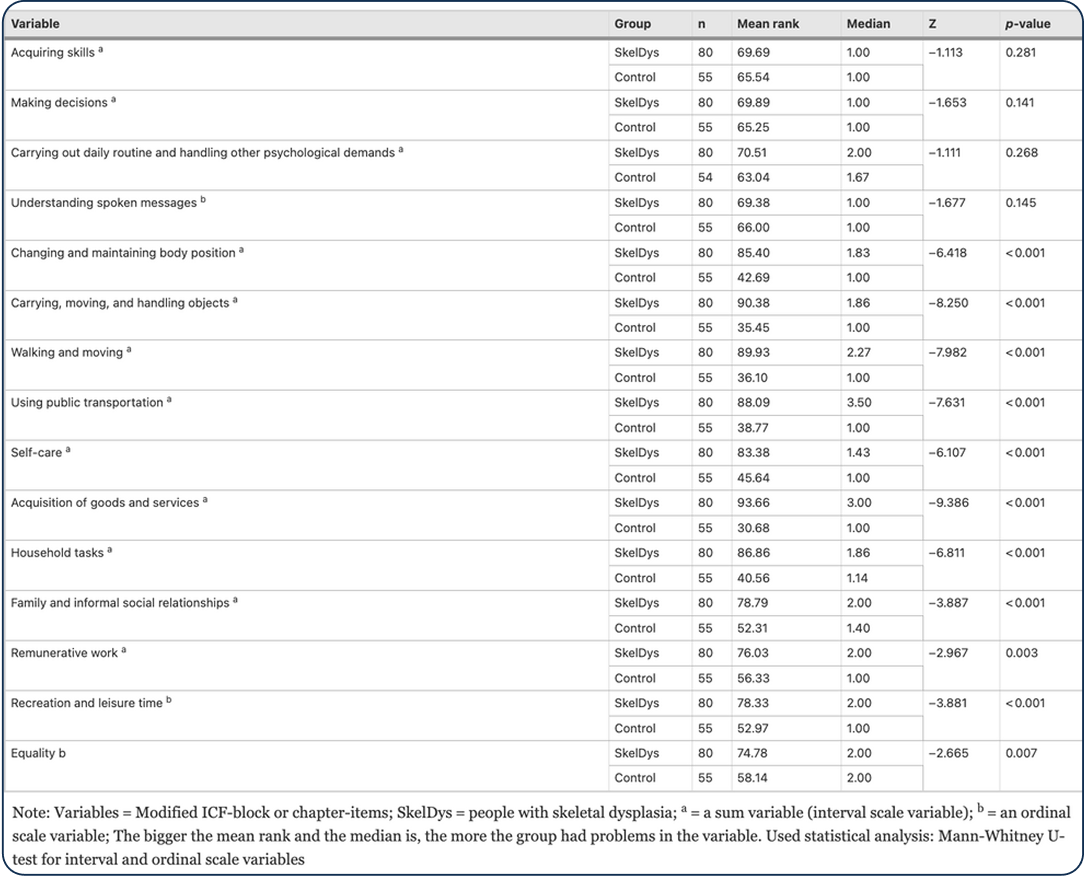
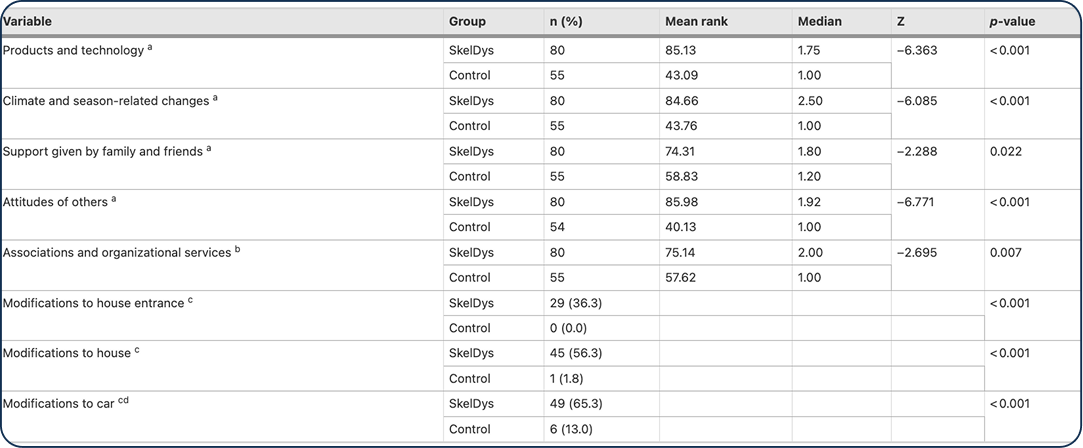
The figures on the left show the differences between people with skeletal dysplasia and control subjects in pain levels, daily functioning, use of assistive devices, and treatment . A p-value below 0.05 means the result is unlikely due to chance. People with skeletal dysplasia reported much more pain and pain affecting their daily lives compared to others (p < 0.001). They also had more trouble with movement, muscle function, and exercise (p < 0.01). Tasks like self-care, household chores, and social activities were harder for them (p < 0.05). They used assistive devices more often than people without skeletal dysplasia (p < 0.001).

Procedure

Participants completed a questionnaire based on ICF categories that incorporated Patient-Reported Outcomes Measurement Information System (PROMIS®) items to evaluate body functions, activities, participation, and use of assistive devices.

Conclusions

​The study demonstrates that skeletal dysplasia significantly affects daily functioning and quality of life. It highlights the important clinical takeaway that improving accessible services and adapting environments can improve daily functioning and support greater equality for individuals with skeletal dysplasia.

My Take

Goal
​I created a survey to better understand the specific challenges people with skeletal dysplasia face, especially after experiencing some myself. The goal was to hear directly from the community about real issues like clothing and vehicle adaptations. By gathering honest, firsthand insights, I aim to find practical ways to improve accessibility and quality of life based on their true needs.
72.7% of respondents found information about driving products moderately to very accessible . 53.6% stated the hardest modifications to learn about were seating, 39.3% said pedal extensions, 39.3% and insurance options.
66.7% of respondents said professional/work attire was the hardest clothing to find, followed by 63.6% for jeans and 51.5% for shoes. 75.8% reported a lack of size or style options as a barrier, 60.6% struggled to find trendy styles, and 21.2% said prices were too high.

46.4% of respondents said desks and workstations are the hardest furniture to find, followed by 42.9% for storage units and 46.4% for seating (chairs with firm support). The biggest challenges when buying furniture were lack of reviews from people with similar needs (43.3%), limited local availability (33.3%), few online options or scattered information (33.3%), and high costs (33.3%).

To improve access for driving , 56.3% wanted insurance assistance, 53.1% preferred step-by-step guides, and 50% valued personal reviews. For clothing, to increase accessibility, 72.7% wanted reviews from the Little People community, 66.7% wanted more representation in mainstream brands, and 48.5% requested better sizing guides.
Overall, the results show that many people with skeletal dysplasia face a range of challenges and want more product reviews from others in the LP community, along with greater representation. To address this, I’ve added a page to the website where individuals can share personal reviews and ask questions about specific adaptive products. There is also a separate page featuring recommended products and practical tips tailored to those with skeletal dysplasia.

Research Studies

  • Hanna, et al. “Functioning and Equality According to International Classification of Functioning, Disability and Health (ICF) in People with Skeletal Dysplasia Compared to Matched Control Subjects – a Cross-Sectional Survey
  • Study – BMC Musculoskeletal Disorders.” BioMed Central, BioMed Central, 4 Dec. 2020, bmcmusculoskeletdisord.biomedcentral.com/articles/10.1186/s12891-020-03835-9/tables/3
  • Hyvönen H, Anttila H, et al. “Functioning and Equality According to International Classification of Functioning, Disability and Health (ICF) in People with Skeletal Dysplasia Compared to Matched Control Subjects – a Cross-Sectional Survey Study.” BMC Musculoskeletal Disorders, U.S. National Library of Medicine, pubmed.ncbi.nlm.nih.gov/33276750/. Accessed 16 July 2025. 

Interviews